

Sarim uses properties attached to equipment and league-inspired account choices to create recognizable playstyles. A perk matters when it changes a decision, not when it merely adds invisible stat noise.
Effects attached to individual equipment pieces.
Longer-term choices attached to the account.
Combat, resource, defensive, and utility decisions.
Item perks
Item perks give individual pieces of equipment an additional purpose. One can reward a spell type, resource pattern, defensive choice, or encounter strategy. This means a nominal upgrade is not automatically the best choice in every situation.
When comparing two items, evaluate the full setup: the activity, the effect you can consistently activate, the resources it saves, and the other perks already in the build. The useful question is not only “which has larger stats?” but “which effect advances this goal?”
Perk Manager
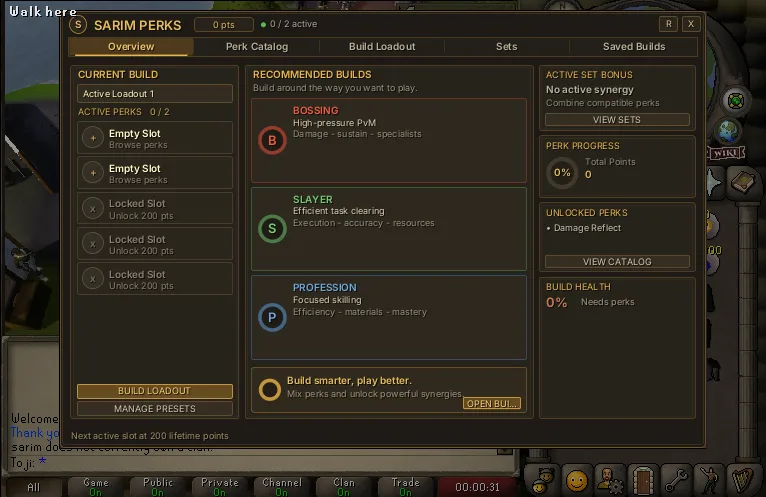
The live Perk Manager keeps active perk slots, recommended Bossing, Slayer, and Profession paths, set bonuses, progress, and saved loadouts visible together. Treat its current in-game descriptions as authoritative for exact effect values and activation rules.
Account perks
Account perks form a broader, league-like progression layer. They can complement a preferred combat style or add utility outside combat. Because these choices operate above a single equipment slot, consider how they support the activities you intend to repeat.
Item and account perks are connected rather than competing systems. Equipment provides situational pieces; account choices supply the longer-term direction. A coherent build uses both layers toward the same purpose.
Building around perks
- Choose an activity. Start with the encounter, skill, or resource problem you want to solve.
- Read exact effects. Check the current in-game wording before planning around an activation condition.
- Combine complementary effects. Prefer a clear plan over collecting unrelated bonuses.
- Test the result. Compare consistency, resource use, and survival—not only maximum damage.
- Save useful loadouts. Keep specialized setups easy to return to.
Sources and related pages
- Designing item and account perks — official development notes.
- Echo bosses — encounters where a planned build can be tested.
- XP rates — choose the pace surrounding perk progression.